
Description
A personal development coach helps you break through confusion, self-doubt, and the feeling of being stuck — learn what personal development coaching is, what coaches actually do, and how to know if it's right for you.
What Is a Personal Development Coach? Everything You Need to Know
TLDR: A personal development coach is a trained professional who helps you close the gap between where you are and where you want to be. Through structured conversations, powerful questions, and accountability, a coach helps you build self-awareness, identify what's holding you back, and take meaningful steps toward a more intentional life. Coaching is not therapy — it's future-focused and action-oriented.
Table of Contents
- What Is Personal Development Coaching?
- What Does a Personal Development Coach Do?
- Personal Development Coaching vs. Therapy: Key Differences
- The Benefits of Working With a Personal Development Coach
- 6 Signs You Might Need a Personal Development Coach
- How Personal Development Coaching Works
- How to Choose a Personal Development Coach
What Is Personal Development Coaching?
Personal development coaching is a structured, goal-oriented relationship between a coach and an individual focused on growth, self-awareness, and meaningful change. It helps people clarify what they truly need, understand what's in the way, and take purposeful action.
Unlike a mentor (who shares their own experience and advice) or a consultant (who prescribes solutions), a personal development coach uses skilled questioning, deep listening, and clear reflection to help you develop your own answers. The belief at the core of this approach: you already have more insight and capacity than you're currently using.
Attune In defines it well: personal development coaching is "a structured process where a coach helps you improve self-awareness, change behaviors, and achieve personal or professional goals through guided sessions and accountability."
The areas of focus vary widely — from confidence and self-doubt, to life transitions, to communication patterns, to relationships, to a simple but persistent sense that something needs to change. What makes it personal development is that the work centers on you as a person, not just your role, title, or performance metrics.
What Does a Personal Development Coach Do?
In a session, a personal development coach doesn't lecture you or tell you what to do. The work is collaborative, and it's led by you.
A personal development coach will typically:
- Create a space where honest reflection is possible — free from judgment, advice, or the pressure to perform
- Ask questions that surface what you actually think rather than what you think you're supposed to think
- Help you identify patterns — recurring thoughts, emotional reactions, or behaviors that keep producing the same results
- Offer direct observations about what they notice in how you talk about yourself or your situation
- Support you in designing actions that move you toward what matters most
- Help you design accountability structures to the commitments you make between sessions
The topics clients bring to personal development coaching are often the ones they can't easily raise with a friend, a manager, or a family member. That's part of why the coaching relationship works — it's designed to be a safe place to say the thing you haven't said yet.
Personal Development Coaching vs. Therapy: Key Differences
This is one of the most common questions people have before starting coaching. The short answer: coaching and therapy serve different purposes, and in some cases, you may benefit from both.
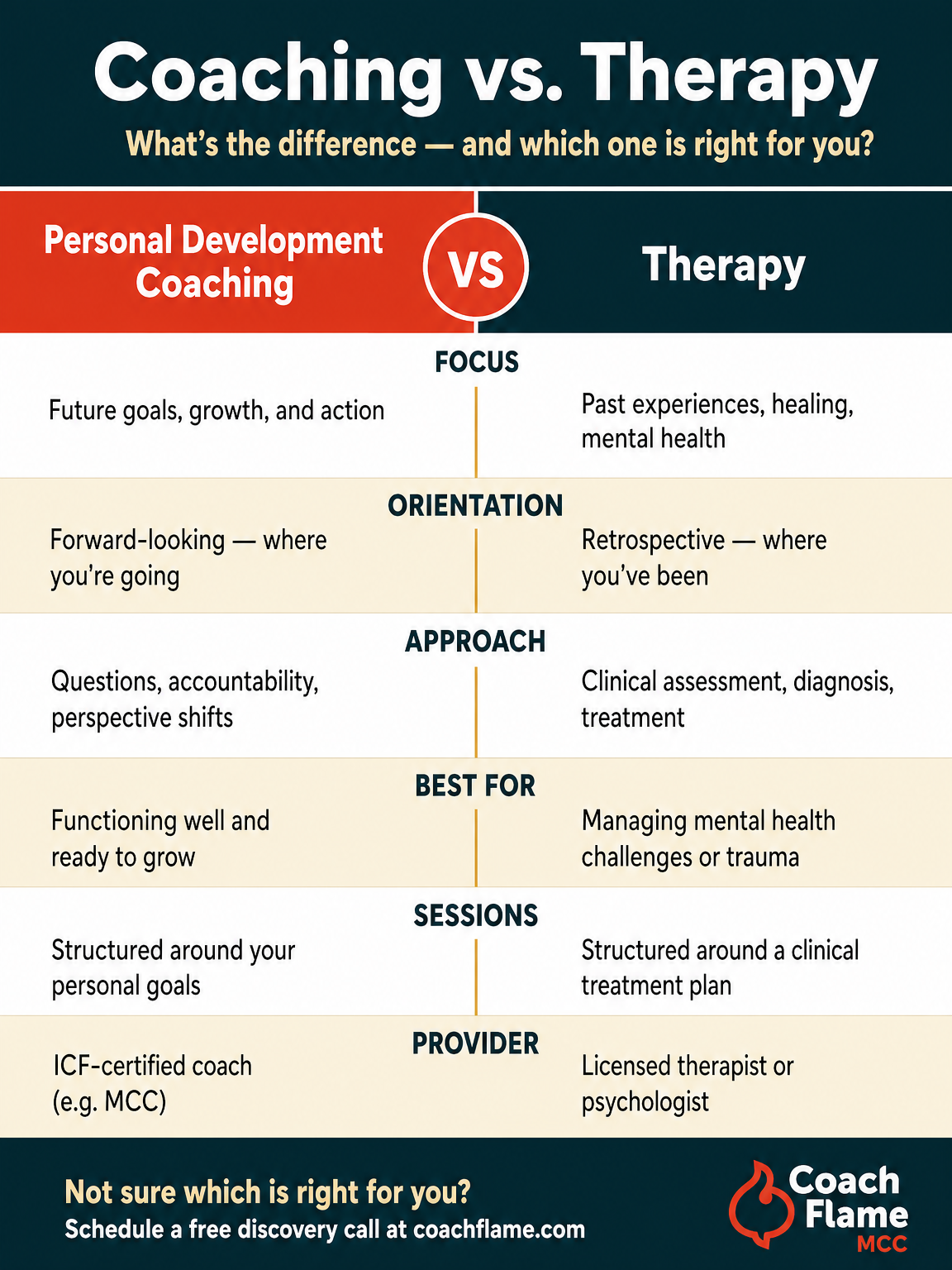
Coaching vs. Therapy Comparison
If you're navigating a mental health condition, processing trauma, or experiencing significant psychological distress, therapy is the appropriate starting point. A good coach will recognize this and refer you out when needed.
If you're generally well but feel stuck, unclear, or ready to make a meaningful change — coaching is built for exactly that.
The Benefits of Working With a Personal Development Coach
The research on coaching is clear: it works. The American Society for Training & Development found that people with a commitment partner have a 65% chance of completing a goal — and when they pair that with regular accountability check-ins, the success rate jumps to 95%.
Personal development coaching delivers specific benefits:
Clarity: Many people come to coaching with a sense of fog — they know something isn't working but can't quite articulate what. Coaching cuts through that fog with targeted questions that get to the real issue faster than self-reflection alone.
Confidence: Working with a coach builds the kind of self-trust that doesn't depend on external validation. You develop a clearer relationship with your own judgment.
Better decisions: When you understand your values more clearly, decision-making becomes less agonizing. You know what matters to you — and that's the foundation of every good choice.
Accountability: Stating your intentions to a coach and following through across multiple sessions builds real momentum in a way that journaling or reading about change rarely does.
Self-awareness: Most people have blind spots about how they come across, how they respond under pressure, or what their recurring patterns actually cost them. A coach helps surface those patterns in a constructive, non-judgmental way.
TDK Strategies notes that coaching helps people "get rid of shortcomings and take effective steps toward a life that is more satisfying" — not through willpower, but through clarity and self-understanding.
6 Signs You Might Need a Personal Development Coach
1. You feel stuck — and you've felt that way for a while
Not the temporary stuck of a bad week. The deeper stuck of knowing something needs to change but not being able to identify what, or how. This kind of stuck usually has something important underneath it.
2. You keep having the same thought over and over
Rumination — turning the same thought over repeatedly without resolution — is often a sign that the issue needs to be addressed in a new way. Thinking harder about it in the same direction rarely produces a breakthrough.
3. You struggle with self-doubt
Self-doubt is a natural fear response to doing something meaningful. But when self-doubt becomes the loudest voice in the room, it starts blocking action that matters to you. Coaching helps you develop a more empowered relationship with that voice.
4. You're in a significant life transition
Career change, leadership role, relationship shift, identity question — transitions put pressure on your sense of self. A coach helps you navigate that pressure with more clarity and less reactivity.
5. You're successful on paper but unfulfilled in practice
You've achieved what you set out to achieve. But something still feels off. This gap between external accomplishment and internal satisfaction is one of the most common things people bring to personal development coaching.
6. You've been in your own way — and you know it
This is the clearest sign. When you can see that your patterns, habits, or beliefs are getting in the way of what you want — but you can't seem to change them alone — a coach provides the structure and perspective to make real change possible.
How Personal Development Coaching Works
Most coaching engagements follow a similar structure:
Initial session: The coach and client get clear on goals, explore current challenges, and agree on what success looks like. This is also where both parties assess whether the relationship is a good fit.
Ongoing sessions: Sessions usually run 60 minutes, typically every two to four weeks. The client sets the agenda for each session, bringing whatever is most alive or most pressing. The coach facilitates exploration, insight, and committed action.
Between sessions: Many clients journal, complete small experiments, or simply pay attention to patterns they've identified in coaching. This reflection between sessions is where a lot of the real integration happens.
Review and evolution: Periodically, coach and client revisit the original goals to assess progress and adjust direction as needed.
How to Choose a Personal Development Coach
When evaluating coaches, look for:
- Credentials from a recognized body like the ICF (International Coaching Federation), which sets standards for coach training, ethics, and practice
- A coaching style that feels right for you — some coaches are more direct; others are more exploratory. An initial call will tell you a lot
- Transparency about process — a good coach will clearly explain how they work, what to expect, and what coaching is not
At Coach Flame, Flame Schoeder, MCC, combines 20+ years of coaching experience with expertise in the Enneagram — a powerful framework for understanding personality patterns and the internal obstacles that keep people stuck. Her approach is direct, compassionate, and built around helping people reconnect with their values and lead a deeply fulfilling life.
Book a discovery call and see for yourself what personal development coaching can open up.
Conclusion
A personal development coach won't fix you — because you're not broken. What coaching does is help you see yourself more clearly, understand what's been in your way, and build the kind of momentum that changes how you show up in every area of your life.
Confusion, self-doubt, and feeling stuck aren't problems to be ashamed of. They're often the first signs that something meaningful is asking to be addressed. A great personal development coach helps you meet that moment with clarity and authenticity.